
From Restructuring Risk to Reliable Figures
Overview
What is a property worth if the existing heating system covers only 28% of the actual peak load and the building is already considered “stranded” according to CRREM?
This was precisely the question facing the buyer of an industrial and office complex shortly before closing. A standard technical due diligence would have documented the structural and technical condition of the property. OPTIMUSE went a step further and translated the identified risks into concrete investment costs and an economically optimized renovation strategy.
To do this, a digital twin was created and five possible renovation scenarios were simulated. The result was €1.48 million in quantified CAPEX for the economically optimal solution, along with a 64% reduction in energy consumption and an 81% reduction in CO₂ emissions.
This provided the buyer with a solid basis for purchase price negotiations and a concrete renovation roadmap for the period following the acquisition.
The Project and the Challenge
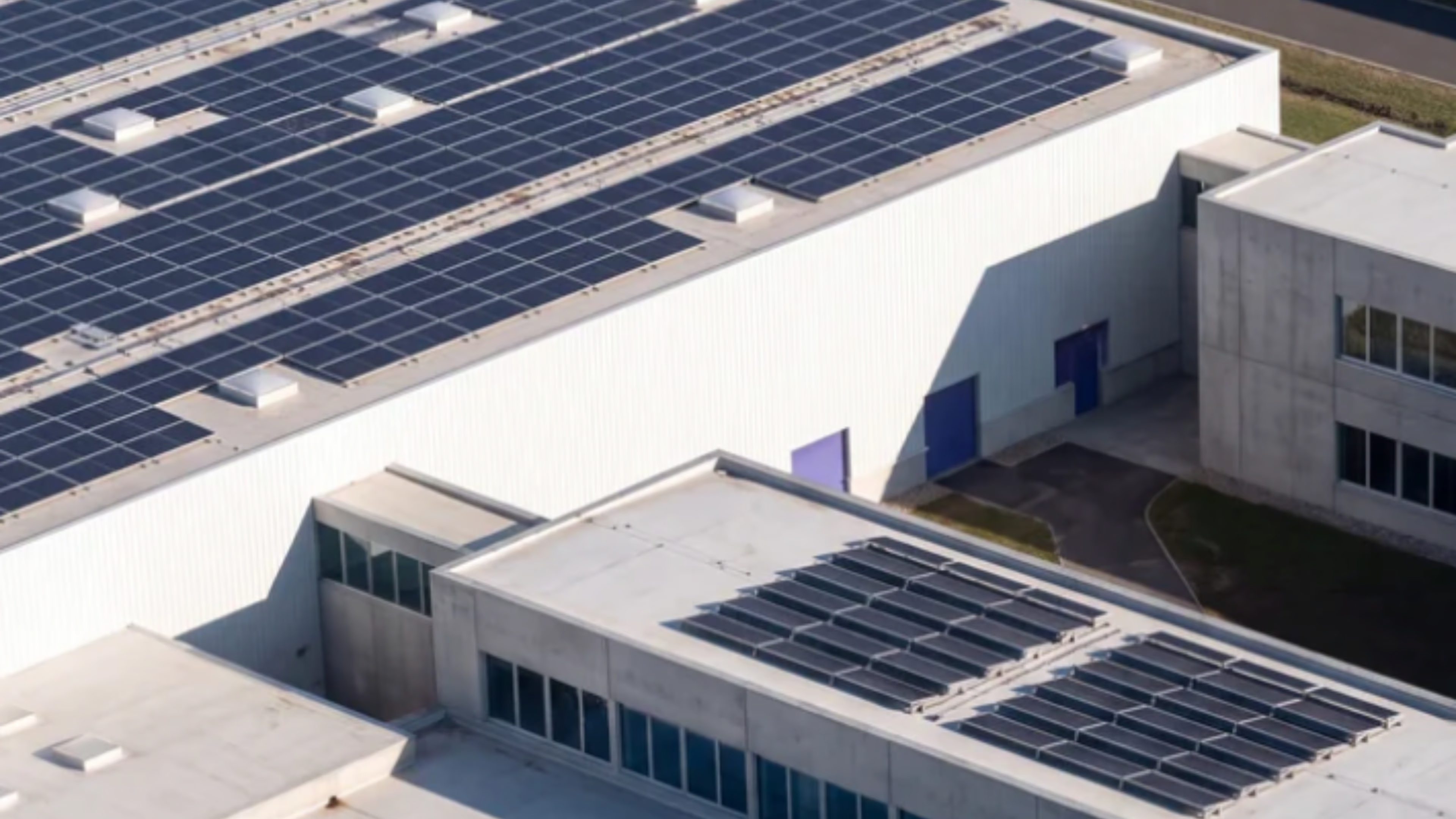
The industrial and office complex under review was built in 1990 and has a gross floor area of 7,280 m². Approximately 4,000 m² is allocated to warehouse and industrial space, and approximately 2,000 m² to office and workshop areas.
The building is heated by a gas boiler with uninsulated heat distribution. Ceiling-mounted radiant heaters are used in the halls, and radiators are used in the office areas. Cooling is available only in the office wing. Mechanical ventilation, heat recovery, and photovoltaic systems are absent. In addition, the membrane roof has reached the end of its service life.
For the buyer, therefore, the issue went beyond a mere assessment of the property’s condition. The key factors were determining which investments would actually be necessary after the purchase and which renovation costs must already be factored into the purchase price.
The technical due diligence of the property should therefore not only identify defects. It should quantify the necessary CAPEX and show which measures make economic sense over the property’s lifecycle.
Risks That Only Became Apparent Through Simulation
The analysis brought two significant risks to light.
The existing gas boiler has a capacity of 211 kW. However, the simulated peak load of the building is around 750 kW. The existing heating system thus covers only 28% of the actual demand.
This supply gap was not clearly apparent during years of ongoing operation.
At the same time, the CRREM analysis showed that the building’s emissions trajectory was already above the permissible decarbonization curve. The property was thus already a stranded asset prior to acquisition.
Without targeted measures, rising operating costs, necessary replacement investments, and a progressive loss of value would have been foreseeable.
Solution Approach
OPTIMUSE created a digital twin of the building using as-built plans, IFC data, and MEP schematics. The model comprised 99 thermal zones and took into account orientation, surroundings, and shading.
Based on this, five renovation strategies were simulated on an hourly basis. Among other options, the analysis examined an LED retrofit, a comprehensive building envelope renovation, the replacement of the heating system, and a complete core renovation.
For each variant, OPTIMUSE calculated the investment costs, energy demand, CO₂ emissions, and discounted life-cycle costs in accordance with VDI 2067.
The combination of an air-to-water heat pump, photovoltaics, and smart LED lighting proved to be the economically optimal strategy.
The decisive factor here was not the maximum possible energy savings. Rather, the key factor was the best balance between investment, operating costs, CO₂ reduction, and reliability of implementation.
64% reduction in energy demand
With the recommended strategy, the specific energy demand drops from 213 to 75 kWh/m²a.
The total annual energy demand is reduced from approximately 1.72 million to approximately 612,000 kWh. This corresponds to a savings of more than 1.1 million kWh per year.
The load profile analysis also showed that a system capacity of 600 kW already covers more than 98% of the annual demand. This allowed the heat pump to be tailored to the building’s actual operating conditions rather than to a few theoretical peak hours.
This prevented unnecessary oversizing.
81% fewer CO₂ emissions
The switch from fossil fuels to an electric supply—partly generated on-site—reduces CO₂ emissions by 81%.
This brings the building back below the relevant CRREM curve. A stranded asset is transformed into a property with a robust decarbonization pathway.
This reduces future economic risks and improves the basis for valuation, financing, and marketing.
€1.48 million in CAPEX as a negotiating lever
The necessary renovation costs were not estimated as a lump sum. The investment costs were calculated for the economically optimal strategy and compared with four alternative options.
The result is a quantified CAPEX requirement of €1.48 million.
For the buyer, this transformed a general renovation risk into a concrete, negotiable figure. The investment requirement could be factored into the purchase price negotiations even before closing.
Economically Sound Rather Than Maximum
The simulation also showed that a complete renovation of the building envelope would not automatically have been the best solution.
A comprehensive building envelope renovation reduced energy consumption only to a limited extent as long as the fossil-fuel-fired heating system remained in place. Even in combination with new system technology, the additional benefit was small relative to the higher CAPEX.
The greatest economic leverage for this property lay in the renewal and precise sizing of the heating system.
Thus, a standard technical due diligence process was transformed into a robust basis for decision-making regarding the purchase price, renovation, and subsequent building operations.
Financial Results
Book a free demo now
Book your free consultation now and find out firsthand how you can save money on your projects with OPTIMUSE.