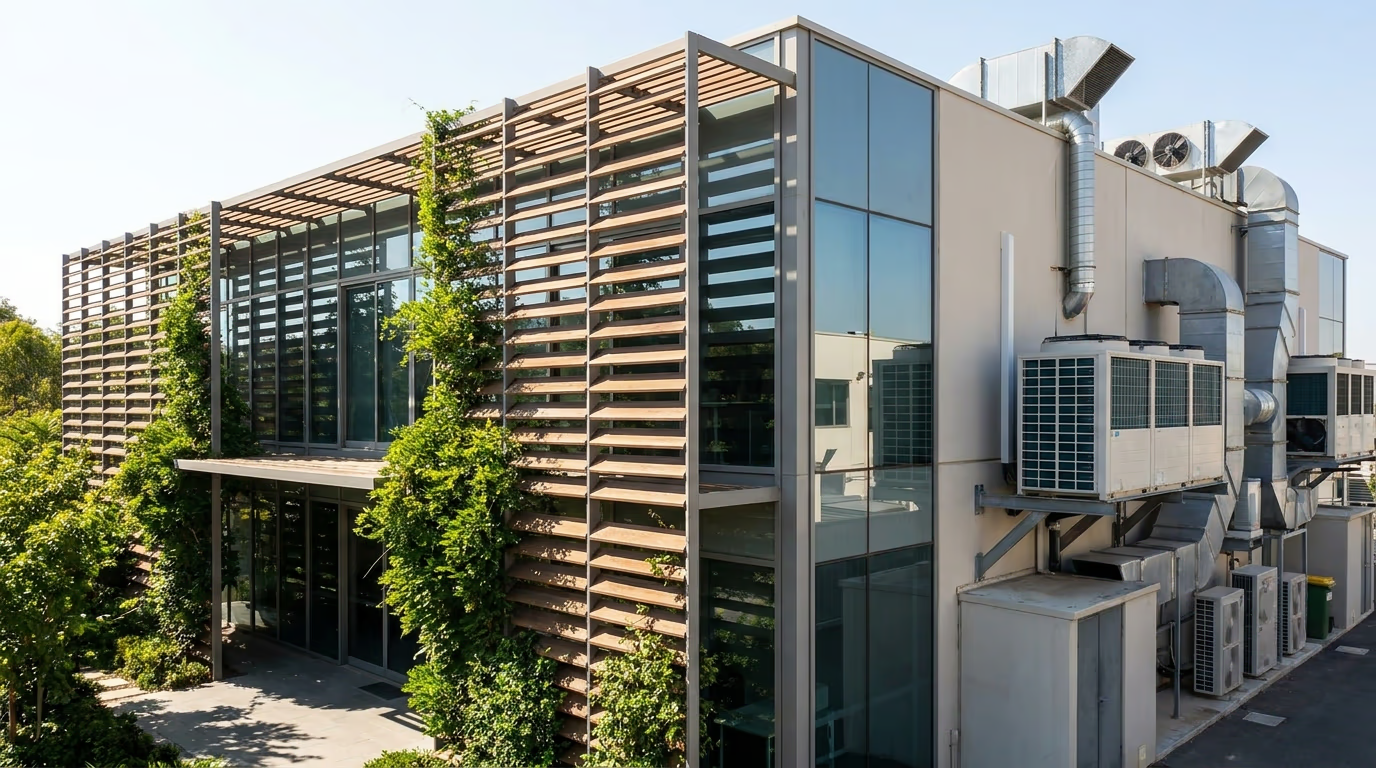
Why the Most Cost-Effective Cooling System Is Mounted on the Facade
Over the past 50 to 60 years, Vienna has seen about 85% more summer days and about 35% fewer days with frost. This isn’t a forecast—it’s a measured fact.
And the trend isn’t reversing. The Climate and Energy Fund estimates that the cooling demand of Austrian buildings will more than double by 2050: from about 12.6 gigawatts of cooling capacity (2021) to as much as 18.6 gigawatts. The number of cooling degree days will rise by about 40% across Austria.
Most building owners respond to this by installing air conditioning. That’s understandable. But it’s the most expensive solution available.
Tomorrow’s climate, planned with yesterday’s standards
Our building stock is designed for a cooler climate. For decades, planning focused almost exclusively on one thing: reducing heating demand. Insulating, building more airtight structures, and eliminating heat loss.
That worked. But it has a side effect that hardly anyone talks about. A well-insulated, airtight building envelope keeps the heat inside—even in summer. The risk of overheating extends from about 3 to 5 to 6 months a year.
Add to that the sun. A window without shading acts like a radiator with an output of over 500 W/m² in the summer. In a 25 m² room, up to 10 kWh of solar radiation enters on a clear day, simply through the glazing. The sun shines on horizontal surfaces with up to 900 W/m².
Anyone who designs such a building using yesterday’s structural assumptions is creating tomorrow’s renovation projects.
Why Air Conditioning Is the Most Expensive Solution
Compression refrigeration—that is, traditional air conditioning—requires about three times as much energy as a heating system to produce the same output. You end up paying dearly to cool what you failed to keep out in the first place.
A global perspective shows where this is leading. In its report “The Future of Cooling,” the International Energy Agency predicts that the number of air conditioners worldwide will rise from 1.6 billion (2018) to 5.6 billion by 2050. That’s 10 units sold per second for three decades. Electricity consumption for cooling will triple by 2050.
Each of these units costs money to purchase, operate, and in terms of its carbon footprint. And each of these units would be smaller if the problem were solved one step earlier: at the building envelope.
Sunshading First, Technology Second
External, dynamic sunshades block solar radiation before it penetrates the building envelope. Without shading, the cooling energy demand quickly reaches around 15 kWh/m² per year. With shading, this figure drops significantly because the heat never enters the room in the first place.
The advantage over fixed solutions lies in their adjustability. An external venetian blind functions like a thermostatic valve: closed in midsummer, open in winter to allow for passive solar gains, and finely adjusted during the transitional seasons. Add to this nighttime ventilation, which dissipates the heat stored during the day in the walls and ceilings.
This is precisely the missing piece of the puzzle—one that is often overlooked. And, as it turns out, it’s missing from the standard as well.
What the OIB Guideline 6 Leaves Unaddressed
For summer-friendly living in Austria, the rule is that energy gain through transparent building components should be less than 15%. This is the basis for many residential construction subsidies and is required by OIB Guideline 6.
Windows alone cannot achieve this. Even modern thermal insulation glass with Low-E coating still allows about 65% of solar energy to pass through, while solar control glass allows about 45%. That’s a long way from the 15% target.
And there’s a catch in the calculation. OIB Guideline 6:2023 assumes that windows are “closed” for the purposes of calculation between 10 p.m. and 6 a.m. Nighttime ventilation—practically the most effective passive measure—can therefore hardly be factored into the verification. The Federal Association for Sun Protection Technology openly criticizes the fact that summer-friendly construction is neglected in the amendment.
In practice, this means that simply meeting the standard does not guarantee a comfortable building. It merely provides a piece of paper.
When the Solution Becomes the Problem
When air conditioning is too expensive and the windows let in too much heat, many people resort to compromises. Most of these end up costing more than they save.
Smaller windows. Sounds logical—less glass, less heat. But this also lets in less daylight, requiring artificial lighting during the day. DIN EN 17037 recommends a window area of at least 20 to 25% of the floor area. At 10%, a room is dark most of the time.
Fixed projections and overhangs. A balcony above a window might provide shade for about 60 days a year, mostly outside peak usage times. However, it reduces daylight 365 days a year—by up to 83% in measured cases. In winter, it blocks the solar gains that you actually want. A year-round compromise.
Solar control glass and window films. Tinted glass reduces heat, but permanently—even in winter. It shifts the color of the light to a greenish hue, then a bluish one, and the hidden costs of artificial lighting don’t appear on any energy performance certificate. If you apply window film to glass that’s already tinted, artificial lighting is necessary even at noon, despite the full glazing.
The common denominator: They all focus on summer and forget about the other nine months.
Daylight is not just a nice-to-have
Today, we spend about 90% of our time indoors. Things were different in Socrates’ day, which is why Mediterranean architectural concepts featuring deep loggias cannot be applied one-to-one to our latitudes.
Daylight has measurable value. In its report “The Business Case for Green Building,” the World Green Building Council estimates up to a 23% increase in productivity with better daylight conditions in the office. Students in well-lit classrooms perform better on tests, and patients with access to daylight and a view recover more quickly.
Artificial light cannot replace this. It does not regulate melatonin or vitamin D synthesis. Those who eliminate daylight to avoid heat are cutting corners in the wrong place.
The practical solution is proper window sizing combined with dynamic sun protection. Plenty of light when you want it, shade when you need it.
Simulation Instead of Guessing: The OPTIMUSE Method
So much for building physics. That leaves the question that’s decided at the conference table: What does it cost, and what are the benefits? And this is precisely where traditional planning falls short. It can hardly predict the interaction between sun protection, daylight, and building systems with any precision.
We take the digital twin approach. Instead of viewing sun protection as a component that’s “planned in at some point,” we run simulations on the entire building before the first screw is even turned. The building envelope, building services, and indoor climate are simulated together, not one after the other.
Specifically, we compare scenarios: with and without solar shading, different types, and automated control. Three key metrics are presented side by side, in black and white.
Construction costs (CAPEX): How small can the chiller be if the facade already keeps the heat out? The simulation shows up to a 10% reduction in investment costs thanks to properly sized systems.
Life-cycle costs (OPEX): How will operating costs evolve over 20 years, given rising electricity prices and more heat waves? Savings of up to 30% are possible here.
CO₂ emissions: Reduced active cooling and optimized material selection significantly lower the carbon footprint, with an eye toward decarbonization pathways (CRREM) and total life-cycle costs.
This applies equally to new construction and existing buildings. For retrofits, we calculate the implications of retrofitting automated external blinds or smart solutions for the existing building systems, as well as the payback period for the investment.
Many building owners are wary of the upfront costs of solar shading. The point of the simulation is to address this concern with numbers rather than promises. You can see the savings in operating costs and CO₂ emissions before construction begins.
The decision is made today
Climate change is advancing; efficient building cooling is becoming more important, not less. The decisions we make today during planning and renovation will determine quality of life and energy costs for decades to come.
Solar shading is not just a minor detail at the end of the design phase. It’s the most cost-effective kilowatt you’ll never have to cool.
If you want to know how much a specific building can save in cooling capacity, operating costs, and CO₂ through dynamic solar shading, we’ll simulate it for you. You’ll receive the three figures (CAPEX, OPEX, CO₂) for your project before you invest. Contact us for an OPTIMUSE simulation.