
Optimized heating system saves
Optimized Industrial Building
Brief Overview
Which heating system is truly cost-effective for an industrial facility—not just at the time of purchase, but over a 25-year period? For META Plant II, OPTIMUSE simulated and optimized the planned heating system and identified the greatest potential for savings. The result: 21.6% lower investment costs, 18.6% lower energy costs, and 20% lower life-cycle costs—the best choice both economically and environmentally, without disrupting the existing plans.
The Project and the Challenge
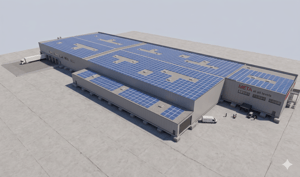
META Plant II is an industrial facility project with large storage areas. The analysis focused specifically on the heating system of the main halls—heat generation and heat distribution. Auxiliary rooms were excluded so that the focus remained on the systems with the greatest economic impact. Getting started was very straightforward for the client. META provided more than 200 documents via a data room. These included as-built drawings, preliminary designs, schematics, and building services documentation, some of which were in PDF format. Also included were the objectives for what needed to be optimized, with a clear focus on cost-effectiveness and sustainability. From this point on, OPTIMUSE took over the entire analysis and optimization process. The original design called for a heat pump with radiant ceiling panels operating at a 45 °C flow temperature. The analysis revealed several weaknesses: a COP of only 1.9 at −10 °C, 39 radiant ceiling panels due to the low flow temperature, and an increased risk of condensation during the transitional season. Specifically, this meant: excessively high investment costs, unnecessarily high energy costs, and a risky system. What was needed was a solution that combined efficiency, cost certainty, and ease of implementation
Solution Approach
Using the more than 200 documents provided, OPTIMUSE automatically created a digital twin of the heating system. Based on this, an AI-powered engine simulated and optimized three alternatives to the existing design, each with a complete life-cycle cost analysis spanning 25 years. This allowed for a direct comparison of investment costs, energy costs, and total costs. The AI-powered analysis identified three optimized system alternatives to the existing plan: Baseline (existing design): Heat pump + 39 radiant ceiling panels at 45 °C flow temperature Option 1: Heat pump + 26 radiant ceiling panels at 65 °C flow temperature Option 2: Heat pump + industrial floor heating at 45 °C flow temperature Option 3: Heat pump + air heater at 65 °C flow temperature Of these three alternatives, Option 1 emerged as the recommended solution. It is based on the same basic principle as the existing design but significantly optimizes it: a more powerful heat pump, a higher flow temperature, better heat distribution—and 13 fewer radiant ceiling panels.
Performance metrics for the optimized solution (Option 1)
Result 1: 21.6% lower capital expenditures (CAPEX) Capital expenditures drop from €347k to €272k—a savings of €75k, or 21.6%. Not by compromising on performance, but through a better-coordinated system: fewer components, less complexity in planning, better performance Result 2: 18.6% lower annual energy costs Annual energy costs drop from €41.6k to €33.9k — a reduction of €7.7k per year. This also means significantly lower energy consumption and reduced CO₂ emissions. The reason: The higher flow temperature of 65 °C distributes heat more efficiently, the more powerful heat pump operates more economically, and 26 ceiling radiant panels instead of 39 reduce overall consumption. Result 3: 20% lower life-cycle costs (LCC) Over 25 years, total costs drop from €1.59 million to €1.27 million—a savings of over €315k, or 20%. And that’s without integrating PV. Option 1 is therefore not only more efficient but also the most resilient solution: it has the lowest increase in operating costs and is the least vulnerable to rising energy prices.
Analysis and Additional Options
Option 1 is not only compelling in terms of the numbers. It requires the least disruption to the existing plans, reduces construction risks, and can be directly incorporated into the construction planning phase. That is the crux of the matter: It’s not the most radical alternative that wins, but the solution with the best balance of investment costs, operating costs, and implementation reliability. Option 1 is the safest investment scenario. A look at the alternatives shows why Option 1 is the best choice: Option 2 (industrial floor heating): High thermal mass, but significantly more expensive to install. There’s also a practical risk: In industrial warehouses, holes are regularly drilled into the floor—for shelving systems, fasteners, and heavy-duty anchors. This would permanently compromise an underfloor heating system. Option 3 (air heaters): An interesting approach, because air heaters can maintain a consistent temperature and balance peak loads. But the cost is high: €96k in annual energy costs and 62% higher lifecycle costs. Significantly less efficient than Option 1. In addition to the heating system, OPTIMUSE examined the effect of integrating a PV system—another lever for simultaneously reducing operating costs and the carbon footprint. The results show that the cost curve flattens measurably. However, the planned PV system is oversized for self-consumption alone. The recommendation: local battery storage or cross-site utilization across the campus to realize the full potential.
Financial Results
Book a free demo now
Book your free consultation now and find out firsthand how you can save money on your projects with OPTIMUSE.